The REAL and RE/MAX Merger is Big, But the Agent Still Matters Most
The merger between Real Broker and RE/MAX is unquestionably big news for the real estate industry. But will joining the right brokerage suddenly turn a struggling real estate agent into a successful one?
No. It will not.
Real’s acquisition of RE/MAX Holdings has officially been completed, creating Real REMAX Group. The combined company brings together Real’s technology and operating model with the global reach and brand recognition of RE/MAX. According to the company, the new organization represents more than 180,000 real estate professionals across more than 120 countries and territories.
That is a major development. But it is not a miracle.
I have been selling real estate in Tampa since 1991. During those 35 years, I have worked with ERA, EXIT Realty, Better Homes and Gardens Real Estate, LPT Realty, and now Real Broker. I have owned a franchise, participated in revenue sharing programs, invested in brokerage stock, built organizations, trained agents, and experienced nearly every kind of real estate market imaginable.
If there is one lesson those 35 years have taught me, it is this: Your brokerage can help position you to win, but it cannot make you get up and go to work.
Real Estate Brokerage Mergers Are Changing the Industry
Consolidation is happening throughout the real estate industry. Real and RE/MAX have combined to form Real REMAX Group. Compass recently completed its acquisition of Anywhere Real Estate, bringing brands including Coldwell Banker, Century 21, Corcoran, and Sotheby’s International Realty under the same corporate umbrella.
These mergers generate excitement, especially among real estate agents. Agents talk about company stock, revenue sharing, technology, marketing, artificial intelligence, future growth, and the possibility of getting involved early in something that could become much larger. There is nothing wrong with that excitement.
If you join a growing brokerage early and want to hold its stock to see what happens, I do not blame you. If you prefer a 100 percent commission company because you believe you can provide everything yourself, that may be the right model for you. If you are a newer agent and a brokerage gives you the marketing, technology, training, and confidence you need to sit across from a client, that has real value.
Every brokerage has something it uses to attract agents. The question is whether that opportunity fits the business you are actually trying to build. But no commission plan, stock award, merger, acquisition, or company announcement can replace the daily work required to become successful.
The Brokerage Is Not Going to Build Your Business for You
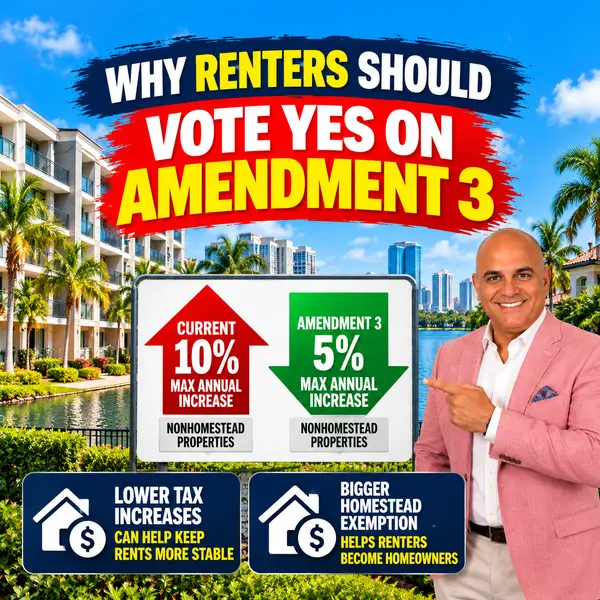
I see agents struggling right now, and I understand why. Florida real estate is a difficult business in the current market. Homeowners insurance remains a major affordability issue. Mortgage rates continue to affect purchasing power. Many sellers are still comparing today’s market to the prices their neighbors received several years ago. Florida voters will consider Amendment 3, which would increase the homestead exemption for non school property taxes to $150,000 in 2027 and $250,000 in 2028 if approved.
Agents are waiting for insurance reform. They are waiting for interest rates to improve. They are waiting for the economy to strengthen. They are waiting for buyers to return and sellers to become more realistic.
The problem is that many of them are doing nothing while they wait.
They are not coming into the office. They are not calling past clients. They are not prospecting. They are not creating content. They are not studying contracts, improving their marketing, attending training, or learning how to communicate with buyers and sellers in a changing market. They are sitting at home hoping the market will rescue them.
It will not.
When the market improves, the agents who kept working during the difficult period will be in the strongest position to benefit. The relationships, skills, visibility, and momentum they are building today will begin paying dividends when transaction volume increases.
COVID Made Real Estate Look Easier Than It Was
During the height of the COVID real estate market, my 90-year-old father probably could have become a new agent and sold $10 million worth of real estate.
Homes were receiving multiple offers almost immediately. Buyers were waiving contingencies. Prices were climbing rapidly, and inventory was disappearing faster than agents could replace it. That market created an illusion. It made some people believe that opening a door and writing an offer was all it took to become a successful real estate agent.
Then the market changed.
The easy transactions disappeared, and the agents who had never developed a real business began struggling. Many did not know how to price a difficult property, create demand, generate their own leads, explain changing market conditions, negotiate through problems, or tell an unrealistic seller what that seller needed to hear.
A great market can hide an agent’s weaknesses. A difficult market exposes them.
I Have Watched This Cycle Before
When I entered Tampa real estate in 1991, the country was coming out of the savings and loan crisis. The market was not handing business to agents. By 2005, Florida real estate was experiencing an absolute frenzy. Then the roller coaster reached the top.
During 2006, the market began turning. By the end of that year, we were heading into a free fall that continued through 2007, 2008, and 2009. Short sales and foreclosures dominated the market. At times, it seemed like nearly every home for sale involved a distressed owner, a lender, or a complicated approval process.
If you refused to learn short sales, you struggled. If you were unwilling to adapt, prospect, and work through difficult transactions, you did not close much business.
The agents who survived were not necessarily the ones with the fanciest brokerage logo. They were the agents who learned what the market demanded and went to work.
Today’s market is different, but the lesson is exactly the same.
Real Estate Success Is 90 Percent Agent and 10 Percent Brokerage
People who are serious about fitness often say results are 90 percent diet and 10 percent gym. Real estate works much the same way.
I believe success is roughly 90 percent the agent and 10 percent the brokerage. That does not mean the brokerage is unimportant. The right 10 percent can make the other 90 percent more productive.
A strong brokerage can provide better technology, training, leadership, marketing, culture, compensation, stock opportunities, revenue sharing, and specialized support. It can save agents time, help them present themselves professionally, and allow them to build more than one source of income.
But the brokerage cannot make an agent pick up the telephone. It cannot force an agent to follow up with a lead, create a video, learn a neighborhood, attend a training session, study a contract, spend money marketing a listing, or have a difficult pricing conversation with a seller.
Those responsibilities still belong to the agent.
Why I Chose Real Broker
I have always tried to put myself in the best possible position to win.
I moved from ERA to EXIT because revenue sharing offered a different opportunity. I later became a Better Homes and Gardens franchise owner and did very well with that model. I was among the earlier agents to join LPT Realty, and I believed its revenue sharing program could become an important part of my eventual retirement strategy.
Then I studied Real Broker.
As someone who recruits agents and builds organizations, I believed Real offered a stronger revenue sharing opportunity for what I was building. The company also offered stock, advanced technology, marketing resources, and several different ways for productive agents to benefit from the platform.
Real was already publicly traded. I was not being asked to wait and hope that an initial public offering might eventually happen. The stock was already real, available, and in play.
During my first two years with the company, that decision has been financially rewarding. The technology has been exceptional, the revenue sharing model fits the organization I have built, and Real’s marketing resources have helped me continue selling higher priced Tampa properties during a challenging Florida housing market.
Real Luxury has also provided specialized support for agents working in the upper tier housing market. That matters when expensive properties require a different level of positioning, presentation, and exposure.
Now, the combination of Real’s technology and business model with the RE/MAX name and worldwide reach creates another potentially significant opportunity.
That is why I believe Real Broker is the best real estate brokerage for where I am in my career today.
Choosing a Brokerage Is Still a Business Decision
I have changed brokerages several times during my career, and I do not apologize for it. Agents are independent businesspeople. We should evaluate our brokerage relationships the same way we evaluate any other major business decision.
Does the company help you make more money? Does its technology save you time? Does its marketing improve the way you serve clients? Does its compensation model reward the business you are building? Does the culture encourage collaboration? Does the leadership have a credible plan for the future? Does the brokerage provide opportunities that extend beyond a single commission check?
Once an agent becomes established, these questions become increasingly important. A new agent may primarily need training, confidence, and basic marketing support. An experienced agent may be more focused on scalability, ownership, stock, revenue sharing, luxury marketing, succession planning, or retirement income.
Different agents need different things at different stages of their careers.
I believe some brokerages take better care of their agents than others. I also believe agents should remain honest about their own contribution to the problem. It is easy to blame a company, a commission split, the market, interest rates, inventory, insurance, or the economy when the agent has not made a prospecting call in three weeks.
No Brokerage Is a Substitute for Work
The Real and RE/MAX merger creates a powerful combination. Real contributes modern technology, an innovative operating model, agent ownership opportunities, and a collaborative culture. RE/MAX brings one of the most recognized names in real estate, decades of history, and a massive global network.
I am excited about what the combination could become.
But Real REMAX Group will not make an unmotivated agent successful. Neither will Compass and Anywhere, a future IPO, a 100 percent commission plan, or the next brokerage promising to revolutionize real estate.
You still have to get up every morning and build your business.
You have to call people when they do not call you. You have to market yourself when business is slow. You have to invest time and money before you know whether either investment will produce a return. You have to remain visible, study the market, tell clients the truth, and continue working when other agents disappear.
The brokerage can provide the gym. The agent still has to control the diet, show up, and do the workout.
Position Yourself Now for the Next Real Estate Market
Florida real estate will eventually turn again. Interest rates will change. Insurance conditions will evolve. Buyer confidence will return. Inventory will tighten in some areas, and transaction volume will increase.
When that happens, the agents who worked through the difficult market will flourish first. They will already have the relationships. They will already have the marketing. They will already understand the inventory. They will already be visible to consumers, and they will know how to turn opportunity into closed business.
After 35 years in Tampa real estate, I still believe that 90 percent of success begins with the agent. But I also believe in aligning that effort with the strongest available opportunity.
Right now, for me, that opportunity is Real Broker and the newly formed Real REMAX Group. It is the combination of betting on yourself and choosing a company that gives you the technology, marketing, compensation, and opportunity to make that bet pay off.
A brokerage merger can create opportunity. Only the agent can turn that opportunity into a career.
Categories
Recent Posts