
Florida Property Taxes: Why Amendment 3 Does Not Hit Local Government Overnight
Florida Property Taxes: Why Amendment 3 Does Not Hit Local Government Overnight
There is something important getting lost in the debate over Florida’s Amendment 3: the proposed property tax changes do not happen overnight.
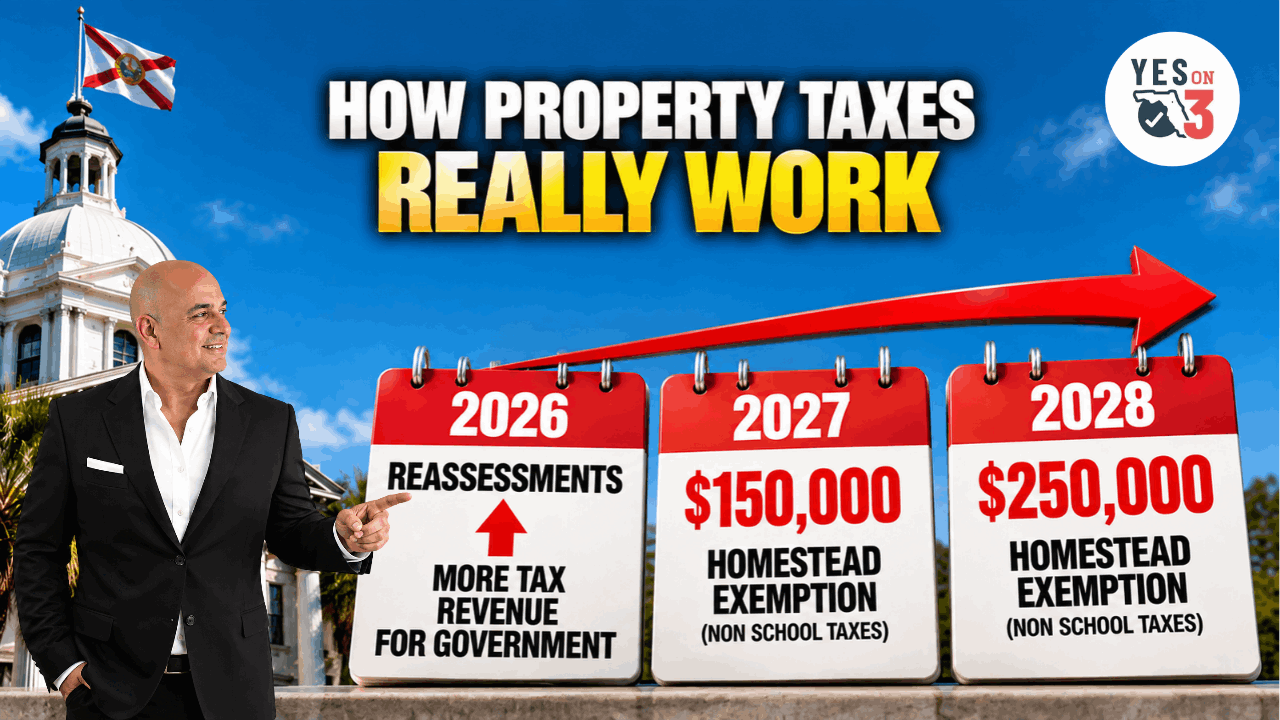
Amendment 3 would increase Florida’s homestead exemption for applicable non school property taxes to $150,000 in 2027 and $250,000 in 2028. That phase in matters because it gives local governments time to adjust their budgets while Florida’s existing property tax system continues operating, including the reassessment of properties following changes in ownership.
First, Understand How Florida Property Taxes Work
Florida property taxes are based on several different numbers. There is the just value, essentially the market value determined by the property appraiser. There is the assessed value, which can be reduced by assessment limitations such as Save Our Homes. Then there is taxable value, which is calculated after applicable exemptions are deducted. Finally, taxable value is multiplied by the applicable millage rates to determine the property tax liability.
For longtime homesteaded homeowners, Save Our Homes generally limits annual increases in assessed value to the lesser of 3 percent or the applicable change in the Consumer Price Index. But that protection does not simply stay attached to a house forever.
What Happens When a Home Is Sold?
This is one of the most misunderstood parts of Florida property taxes. When a protected homestead changes ownership, the previous owner's Save Our Homes protection generally comes off the property and the home is reassessed at just value on January 1 following the change in ownership.
Imagine a longtime homeowner whose property has a market value of $600,000 but, because of years of Save Our Homes protection, has an assessed value substantially below that amount. When that home sells, the new owner does not simply inherit the seller's old assessment. The property generally resets to just value the following January 1, subject to exemptions and benefits for which the new owner qualifies. That reassessment process continues regardless of Amendment 3.
Now Look at the Timing of Amendment 3
This is where the phase in becomes extremely important. Amendment 3 does not immediately establish a $250,000 homestead exemption. Instead, the increased exemption for applicable non school property taxes would be $150,000 in 2027 and $250,000 in 2028.
That means local governments are not being asked to adjust instantly to the full $250,000 exemption. They receive a transition period while Florida real estate continues changing hands.
Homes sold during 2026 can be reassessed for 2027. Homes sold during 2027 can be reassessed for 2028. New construction can add taxable value. Property values can change. Existing homestead assessments can continue increasing within the Save Our Homes limitation.
In other words, the property tax base does not simply freeze while the exemption increases.
There Are Two Sides to the Revenue Equation
Opponents of Amendment 3 have focused heavily on the revenue local governments could lose because of the larger homestead exemption. That is a legitimate number to examine, but it is not the only number that matters.
A complete discussion should also examine revenue generated by reassessments, new construction, changes in taxable value and growth in the overall tax base. Every time a longtime protected property changes ownership, its accumulated Save Our Homes assessment difference can disappear, subject to portability available to an eligible homeowner, and the property can be reassessed at current just value.
So when discussing the fiscal effects of Amendment 3, Floridians deserve to see both sides of the equation: How much taxable value is reduced by the larger exemption? How much new taxable value is created through reassessments? How much is added through new construction and rising assessments? And what spending adjustments can local governments make during the phase in?
2027 Is a Transition Year
This may be the most important point. The full $250,000 exemption does not arrive until 2028. During 2027, the exemption would be $150,000 for applicable non school property taxes.
That gives local governments another budget cycle before the full exemption takes effect, and throughout that period property reassessments continue.
That does not mean every dollar of increased assessed value automatically becomes additional spendable government revenue. Millage rates, exemptions, portability and individual property circumstances affect the final tax bill. But it does mean that Florida’s property tax revenue machinery does not suddenly stop operating because Amendment 3 passes.
It keeps moving.
What About Government Spending?
This is the other side of the conversation. If counties and municipalities say a larger homestead exemption will require budget adjustments, taxpayers have every right to examine how existing tax dollars are currently being spent.
Audits, efficiency reviews and spending investigations should be evaluated based on what they actually find. Questionable or potentially wasteful spending is not automatically fraud, nor does every identified expenditure represent money that can immediately be recovered. But those findings absolutely raise legitimate questions.
Which expenditures are essential? Which are discretionary? Where can operations become more efficient? Which spending increases are sustainable? What changes can be made during 2027 before the full exemption takes effect in 2028?
That is exactly why the phase in matters. Government has time to adjust.
But Homeowners Are Adjusting Right Now
Government budgets matter, but so do household budgets. Property taxes are not an accounting exercise to homeowners. They are part of the monthly cost of keeping a roof over their heads.
For buyers, property taxes affect mortgage qualification and monthly housing costs. For landlords, property taxes are an operating expense that can affect rents. And for someone buying a longtime homesteaded property, reassessment can produce a dramatically different tax bill from the one paid by the previous owner.
That is why I believe the urgency in this debate needs to include what is happening at the kitchen table, not just what is happening inside government buildings.
Understand the Timeline Before Calling It an Emergency
Amendment 3 does not impose the full $250,000 exemption on January 1, 2027.
The exemption is phased in. Reassessments continue. Properties continue changing hands. New construction continues. The tax base continues changing. And local governments have time to examine their budgets before the full $250,000 exemption takes effect in 2028.
There are legitimate questions about how Amendment 3 would affect taxpayers and local government revenue, and Floridians deserve to see both sides of that equation.
Government has time to make adjustments. Florida homeowners are dealing with the cost of housing today.
Before anyone declares a fiscal emergency for government, we should make sure we are not overlooking the financial emergency already happening in households across Florida.
Vincent Arcuri, Realtor in Tampa since 1991, 813-Vincent
Categories
Recent Posts