Florida Amendment 3 and the Three Legged Stool Threatening Homeownership
 Florida Amendment 3 and the Three Legged Stool Threatening Homeownership
Florida Homeowners Are Being Squeezed From Three Directions
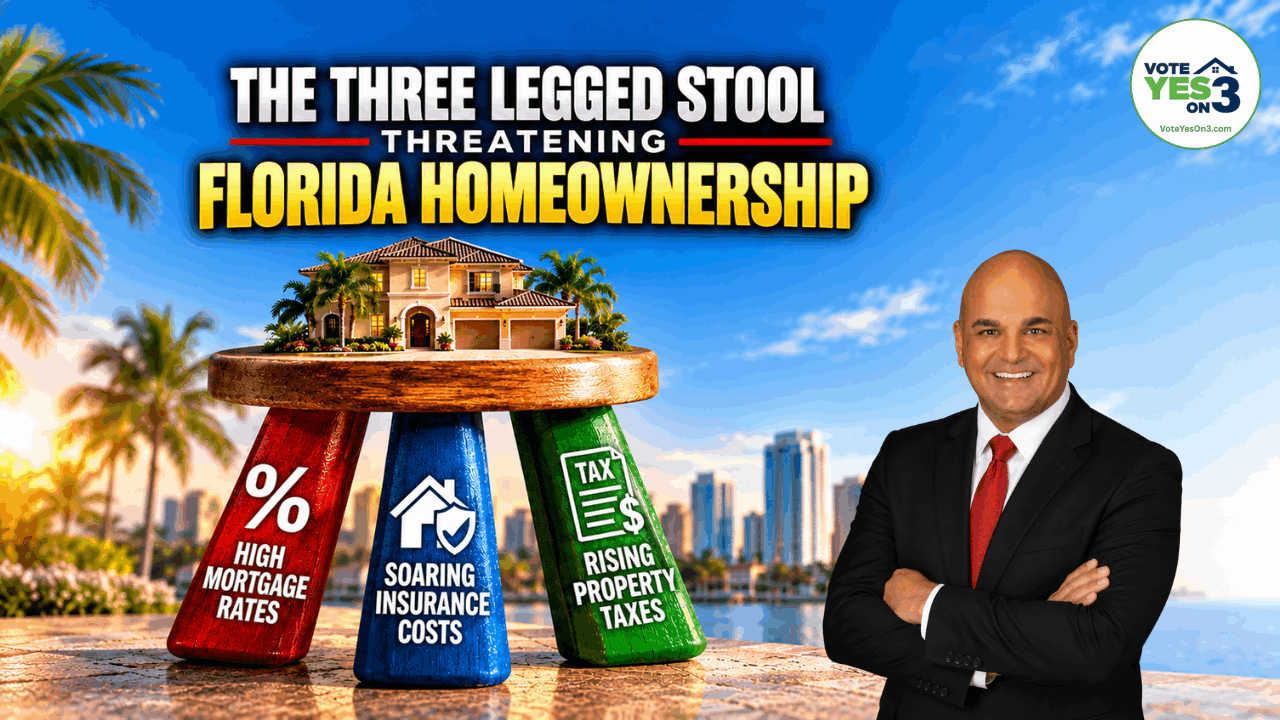
I have been selling real estate in Florida since 1991, and for years I have described the real estate market as a stool. There are several factors holding that stool up, but when it comes to housing affordability in Florida today, three legs deserve particular attention:
Mortgage interest rates. Homeowners insurance. Property taxes.
All three ultimately end up in the same place: the homeowner's monthly housing expense. That matters because buyers don't simply buy a house based on its sales price. They have to qualify for and live with the monthly payment. That distinction helps explain why the debate surrounding Florida Amendment 3, property taxes and the Florida homestead exemption is about much more than a tax bill.
It's about housing affordability. It's about first time homebuyers. It's about seniors trying to remain in their homes. It's about existing homeowners trying to preserve their equity. And it's about what happens to the Florida real estate market when the total monthly cost of owning a home becomes increasingly difficult for ordinary families to afford.
The First Leg: Mortgage Interest Rates
It wasn't that long ago that qualified homebuyers could obtain mortgage rates near 3 percent. Those historically low rates dramatically increased purchasing power. When mortgage rates move into the 6 percent or 7 percent range, the exact same mortgage produces a substantially larger principal and interest payment.
Consider a simple example.
A $400,000 mortgage at 3 percent for 30 years has principal and interest of approximately $1,686 per month. At roughly 7 percent, that payment jumps to approximately $2,661 per month. That's almost $1,000 more every month. The buyer didn't get a bigger house. The buyer didn't get another bedroom. The buyer didn't get another bathroom. The buyer simply borrowed the same amount of money at a much higher interest rate.
And principal and interest are only the beginning.
The Second Leg: Florida Homeowners Insurance
Anyone who has bought or owned a home in Florida during the last several years knows that property insurance can have an enormous effect on affordability. There have been encouraging signs from recent Florida insurance reforms. Litigation has fallen, insurers have filed rate reductions and additional companies have entered or reentered the Florida market. But insurance remains a significant part of the affordability calculation for many Florida homeowners. A $6,000 annual homeowners insurance premium represents another $500 per month in housing expense. That means a buyer isn't simply asking:
Can I afford the mortgage?
The real question is:
Can I afford the mortgage, homeowners insurance, property taxes and potentially HOA or condominium expenses? This is why focusing exclusively on the sales price of a home can miss the larger affordability problem.
The Third Leg: Florida Property Taxes
This brings us to property taxes and Florida Amendment 3. Florida's existing homestead exemption has long provided important protection for qualifying primary residences. The proposal appearing on the November 3, 2026 ballot would substantially increase the exemption applicable to non school property taxes. Under Amendment 3, the applicable homestead exemption would increase from $50,000 to $150,000 beginning January 1, 2027, and then to $250,000 beginning January 1, 2028. School district levies are treated differently and are not included in that increased exemption. The proposal also contains provisions affecting non homestead property assessments and the use of certain local property tax revenues. Those details matter because property taxes are one of the major components of a homeowner's monthly payment.
Why the Previous Owner's Property Tax Bill Can Be Misleading
This is something Florida homebuyers need to understand. The property tax bill being paid by the person selling a house is not necessarily a good indication of what the next owner will pay. A longtime Florida homeowner may have accumulated substantial protection under Save Our Homes, which generally limits annual increases in the assessed value of a qualifying homestead. After a change of ownership, however, the property can be reassessed under Florida law. That can produce a dramatically different tax bill for the new owner. Imagine looking at a house where the current owner pays $3,000 per year in property taxes.
That's $250 per month.
If the new owner's eventual tax obligation were $12,000 annually, that would be $1,000 per month. That's a difference of $750 every month.The actual tax change depends on the property, its assessed value, exemptions and applicable taxing authorities, so buyers should never assume that example applies automatically to their property. But the underlying issue is very real.
Property taxes affect purchasing power.
Buyers Don't Live in the Sales Price. They Live in the Payment.
Put these expenses together. A buyer could face: Higher mortgage interest costs. Hundreds of dollars per month for homeowners insurance. Hundreds or potentially more than $1,000 per month in property taxes depending on the property. And possibly HOA dues, CDD assessments or condominium fees on top of that. This is why affordability cannot be measured by looking at home prices alone. A house can decline in price and still become more expensive to own if financing, insurance and taxes increase enough. That's one of the most important realities facing the Florida real estate market.
What Happened to the First Time Homebuyer?
Here's another number that deserves attention. When I started selling real estate in 1991, the typical first time homebuyer was dramatically younger than today's buyer. Historical National Association of Realtors data show the median age of a first time buyer was around the late 20s to early 30s in that era. More recent NAR data put the median first time buyer at 40 years old in 2025, a record high.
That isn't a small demographic change.
It represents an enormous shift in when Americans are reaching one of the traditional milestones of financial independence. Recent housing research also shows why. Home prices increased dramatically after 2019 while household incomes grew much more slowly. At the same time, buyers faced elevated mortgage rates and, particularly in Florida, substantial insurance and property tax expenses. For many younger Americans, homeownership isn't being postponed for a few months. It can be postponed for years. Some continue living with parents. Others continue renting while attempting to save enough money for a down payment and closing costs. And every year that passes without purchasing a home can also mean another year without building equity through homeownership.
Is the Florida Housing Market Really Crashing?
This is where it's important to separate concern about affordability from what the statewide numbers actually show. Some Florida communities, property types and price ranges have experienced price declines. But as of mid 2026, Florida Realtors data do not show a statewide housing market crash. In the second quarter of 2026, Florida's median single family sales price was approximately $425,000, up 2.4 percent from the same quarter in 2025. In July, the statewide single family median price was again approximately $425,000, up 3.7 percent year over year.
Florida is a collection of local real estate markets, however. Tampa Bay real estate, Miami real estate, Orlando real estate, Southwest Florida real estate and other Florida housing markets can behave very differently. Condos can behave differently from single family homes. One price range can decline while another remains strong. So homeowners should pay attention to their local housing market, not just statewide headlines.
Could Rising Ownership Costs Put Downward Pressure on Florida Home Values?
This is the larger economic question. There is no way to responsibly say that one ballot measure alone will determine whether Florida experiences a housing crash or recession. Housing markets are affected by mortgage rates, employment, household income, population growth, inventory, new construction, insurance availability, property taxes, consumer confidence and the overall economy. But affordability unquestionably matters. When the monthly cost of owning a home rises, buyers' purchasing power can decline. When purchasing power declines sufficiently, sellers may eventually have to adjust prices to meet what qualified buyers can afford.
That relationship is why homeowners should pay attention not only to mortgage rates and sales prices but also to the expenses surrounding homeownership.
The Polk County Property Tax Numbers Deserve Attention
The current debate over Amendment 3 has included warnings from local government and public safety officials about the potential effect of reduced property tax revenue. Polk County Sheriff Grady Judd, for example, has publicly opposed Amendment 3 and called the proposal a "train wreck." He has argued that reductions in local government property tax revenue could affect law enforcement, fire and emergency services, roads and stormwater infrastructure. Those concerns deserve to be understood. But homeowners should also look at the other side of the financial equation: How much has property tax revenue already increased?
According to Polk County's own financial reports, county property tax revenue was approximately:
2018: $222.9 million
2019: $255.5 million
2020: $274.7 million
2021: $288.1 million
2022: $314.5 million
2023: $358.2 million
The Polk County Clerk subsequently reported that property tax revenue increased another $42 million, or 10.2 percent, in fiscal year 2025 alone. That's important context for any discussion about future property tax revenue. It doesn't automatically establish that every proposed reduction can occur without consequences. Polk County has also experienced substantial population growth, development and increased demand for public services. But taxpayers can reasonably examine both sides of the equation:
What services must local government provide?
And:
How quickly have the revenues funding government grown?
Both questions belong in the discussion.
What Amendment 3 Would Actually Do
Florida voters should understand the proposal before making their decision. Among its major provisions, Amendment 3 would phase in a larger homestead exemption for qualifying properties. For applicable non school property taxes:
2027: up to $150,000 of assessed value
2028: up to $250,000 of assessed value
The amendment also reduces the annual assessment growth cap for certain non homestead property from 10 percent to 5 percent. Importantly, the increased homestead exemption does not apply to school district levies. The measure requires at least 60 percent voter approval to become part of the Florida Constitution.
Why Property Tax Policy and Real Estate Are Connected
Property tax policy doesn't exist in a vacuum. Neither does homeowners insurance. Neither do mortgage rates. They all affect the monthly cost of owning a Florida home. Suppose mortgage rates eventually decline. That could increase purchasing power. Suppose Florida's insurance market continues improving and premiums stabilize or decline. That could improve affordability. Suppose property tax obligations are reduced for qualifying homeowners. That could affect the monthly housing expense as well. Conversely, if financing, insurance, taxes and other ownership expenses remain elevated simultaneously, those costs can continue putting pressure on household budgets.
That's the three legged stool.
What Happens If Florida Home Values Decline?
There is another part of the property tax discussion that shouldn't be ignored. Local governments benefit from a healthy real estate market and a healthy tax base. If economic conditions eventually caused widespread property values to decline, the effects could ultimately reach government revenue as well. The relationship isn't immediate or perfectly proportional because Florida property taxation involves assessed values, exemptions, Save Our Homes protections, millage rates and other rules.
But property values and the tax base are connected. That means homeowners and local governments share an interest in maintaining a sustainable housing market.
The Real Question Is Housing Affordability
Florida's housing debate sometimes becomes a fight between taxpayers and government. I think the more useful question is larger: How do we make homeownership sustainable while continuing to fund the public services Florida communities require? That's the challenge. Homeowners need police and fire protection. They need roads. They need infrastructure. They need schools and other public services.
But Florida also needs people who can afford to purchase and remain in their homes. If homeownership becomes something available primarily to people with substantial incomes or accumulated wealth, Florida faces a much deeper long term housing problem.
I've Watched Florida Real Estate for 35 Years
I've been a licensed Florida Realtor since 1991. I've sold real estate through dramatically different markets. I've watched interest rates rise and fall. I've worked through recessions. I've experienced the Savings and Loan era, the housing boom, the foreclosure and short sale crisis, the Great Recession, the extraordinarily low mortgage rates following the pandemic and the affordability challenges that followed. Every real estate cycle is different. But one principle remains remarkably consistent:
The monthly payment matters.
You cannot endlessly increase the expenses surrounding homeownership without eventually affecting what buyers can afford to pay for the underlying property. That's why mortgage rates matter. That's why homeowners insurance matters. And that's why property taxes matter.
Florida Voters Have a Major Decision on November 3
Amendment 3 puts a significant property tax proposal before Florida voters on November 3, 2026. Supporters emphasize property tax relief and housing affordability. Opponents, including some local government and public safety officials, warn about the potential effects on local government revenue and services. Those competing considerations deserve serious examination. Look at what the amendment actually says. Look at your property tax bill. Look at how your local government's property tax collections have changed. Look at the cost of homeowners insurance. Look at current mortgage rates. Look at what's happening to first time homebuyers. And most importantly, look at what all of those expenses mean when they're combined into the monthly cost of owning a home.
Because whether you're buying a home in Tampa, selling a home in Tampa Bay, considering moving to Florida or simply trying to remain in the home you already own, housing affordability isn't determined by one number. It's the entire payment. And right now, those three legs of the Florida housing stool deserve everyone's attention.
Florida Real Estate and Amendment 3 Resources
For information about buying or selling a home in Tampa Bay, Florida property values, Tampa real estate, Tampa Bay homes for sale, Florida housing affordability, Florida property taxes, Florida homestead exemptions, Save Our Homes, Amendment 3 and the Tampa Bay real estate market, continue following my real estate updates and market reports.
Vincent Arcuri, Realtor
Florida Realtor since 1991
Categories
Recent Posts