The First Time Homebuyer Dilemma: Are We Creating a Generation That Has to Inherit a Home?
The First Time Homebuyer Dilemma: Are We Creating a Generation That Has to Inherit a Home?
For decades, buying your first home was one of the most important milestones of adulthood. Today, that milestone is moving further and further out of reach.
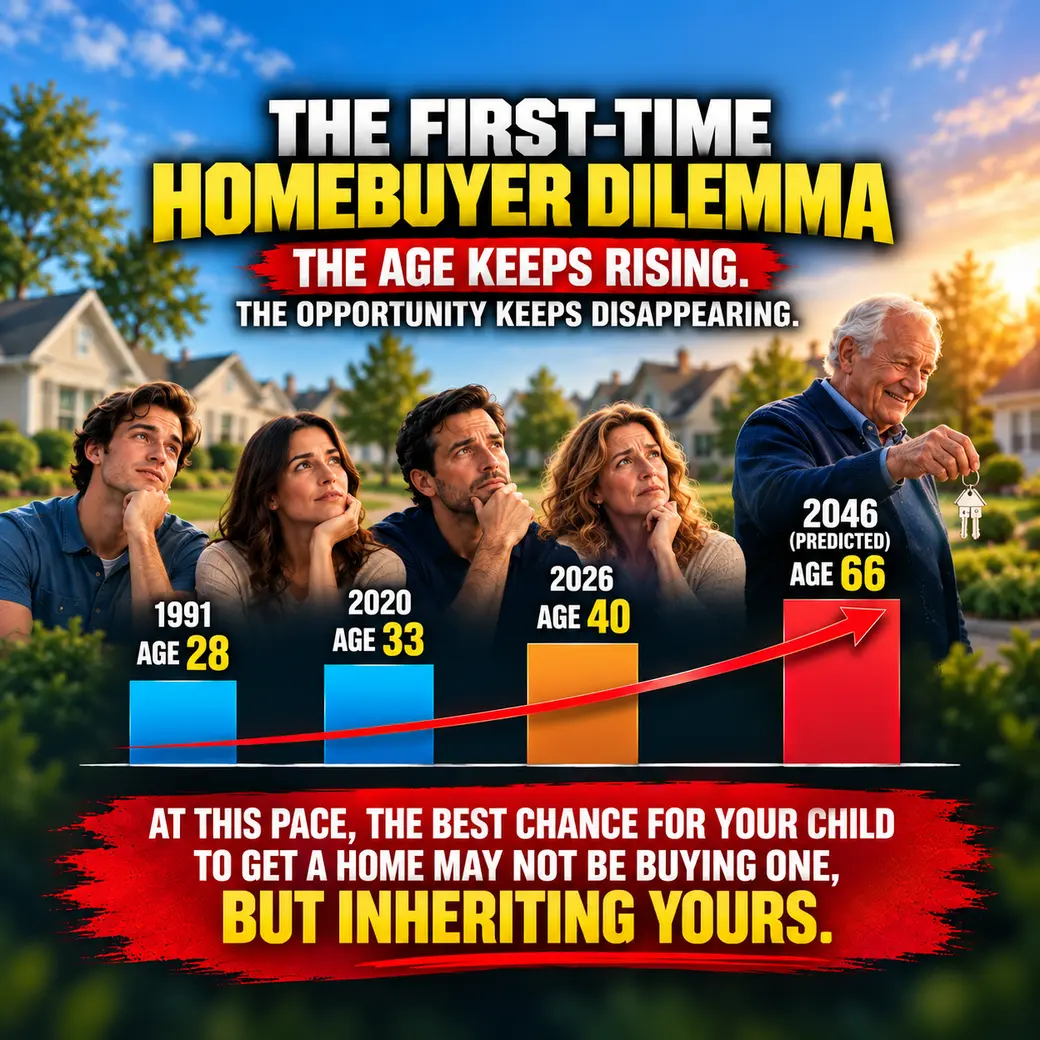
In 1991, the typical first time homebuyer was just 28 years old. By 2020, that number had risen to 33. Think about that for a moment. Over nearly three decades, the age increased by only five years. Today, the median age of a first time homebuyer has reached 40 years old, an all time high according to the National Association of Realtors. Even more alarming, first time buyers now represent just 21% of all homebuyers, the lowest level ever recorded by NAR.
THE TREND HAS ACCELERATED
For decades, the typical first time buyer was generally in their late 20s or early 30s. Now they're 40. This isn't simply about someone waiting a couple of extra years to buy a house. Delaying homeownership can mean losing years of appreciation, principal reduction and wealth creation. NAR estimates that delaying homeownership until age 40 instead of 30 can mean roughly $150,000 in lost equity on a typical starter home.
THE COST OF THE HOUSE IS ONLY PART OF THE PROBLEM
One of the biggest mistakes we make when discussing housing affordability is focusing only on the sales price and mortgage rate. A buyer doesn't just have to qualify for principal and interest. They also have to afford property taxes and homeowners insurance, and those costs can dramatically change the monthly payment. NAR has specifically identified rising property taxes and homeowners insurance premiums as factors pushing the true cost of homeownership higher. In 2026, NAR even introduced an insurance adjusted affordability measure because traditional affordability calculations can understate what today's buyer actually has to spend each month.
That is why housing affordability cannot be fixed by talking only about mortgage rates. We need property tax reform, and we need continued homeowners insurance reform. Florida's insurance market has recently shown signs of stabilization, with many insurers filing flat or lower rates, but affordability remains a major issue for homeowners and buyers. We need to continue pushing that progress while attacking the other growing costs of owning a home.
FLORIDA'S AMENDMENT 3 AND PROPERTY TAX RELIEF
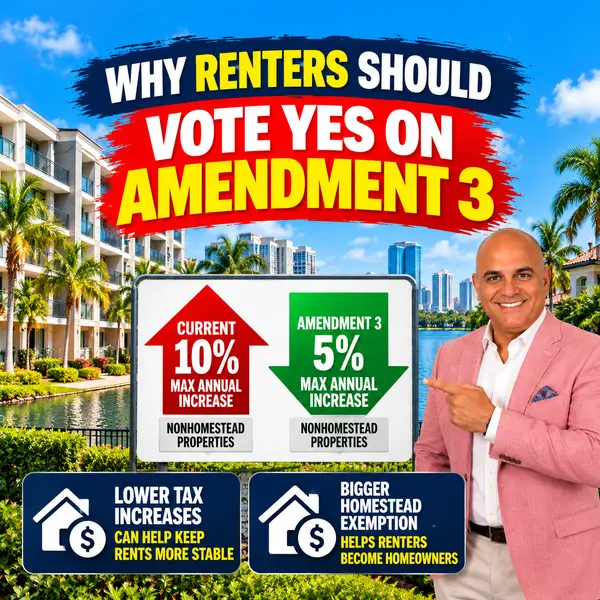
That brings us to Amendment 3. Florida's proposed Amendment 3 would increase the homestead exemption for non school property taxes to $150,000 in 2027 and $250,000 in 2028 for qualifying Florida residents, with inflation adjustments beginning in 2029. It would also reduce the annual assessment growth cap on non homestead property from 10% to 5%. School taxes are excluded from these changes.
For eligible homeowners, that means a larger portion of the home's assessed value would be protected from non school property taxes. For eligible first time buyers establishing a Florida homestead, lower ongoing property taxes can make the total cost of ownership more manageable. The exact benefit depends on the buyer's circumstances, when Florida residency was established, the property's assessed value and local tax rates.
Amendment 3 does not solve the entire housing affordability problem. No single constitutional amendment could. But property taxes are part of the monthly housing cost, and reducing that burden is one way Florida can address affordability while broader insurance and housing reforms continue.
WHAT HAPPENS IF WE DON'T CHANGE THE TRAJECTORY?
Nobody can responsibly tell you that the median first time buyer will definitely be 50 in 2036 or 66 in 2046. Those are not official forecasts. But look at the direction and ask the question: What happens if we allow homeownership costs to keep pushing the starting line further and further away? What happens if today's 20 year old doesn't buy at 28, 30 or 35? What happens if that becomes 40, 45 or 50?
At some point, we have to confront an uncomfortable possibility.
The best chance some of our children may eventually have to own a home could be waiting for their parents to die and inheriting theirs. Think about how backwards that would be. Instead of parents celebrating as their children receive the keys to their first home at 28 or 30, the transfer of homeownership happens decades later when the parents pass away.
That's not creating homeowners. That's creating heirs.
HOMEOWNERSHIP IS HOW GENERATIONAL WEALTH BEGINS
A home has traditionally been one of the greatest wealth building tools available to middle class American families. You buy young. You build equity. You raise your family. Eventually you sell, move up, downsize or retire with decades of accumulated equity. But what happens when that process doesn't begin until you're 40? You haven't simply postponed buying a house. You've potentially lost a decade or more of equity growth and wealth creation. You may eliminate an entire move up cycle. And the next generation starts even further behind.
We're already seeing evidence of a generational shift. In NAR's latest data, only 24% of recent buyers had children under 18, compared with 58% in 1985. First time buyers account for only 21% of purchasers, while Baby Boomers represent a much larger share of today's buyers.
The people who already accumulated housing equity have an enormous advantage. The people trying to create that equity for the first time are struggling just to get through the front door.
WHERE DOES THIS END?
If the typical first time buyer went from 33 in 2020 to 40 today, what does homeownership look like for today's 15 year old when he or she turns 30? What does it look like for today's five year old? We should not simply accept a future where each generation has to wait longer than the generation before it to own a home. We need more attainable housing. We need property tax reform. We need continued homeowners insurance reform. We need to address the entire monthly cost of owning a home, not simply the purchase price. In Florida, Amendment 3 is one proposal voters will consider in November that would reduce certain property taxes for qualifying homeowners. Whether voters support or oppose it, the larger affordability question isn't going away: How do we make buying and keeping a home achievable for the next generation?
Because if we don't change the trajectory, one day the conversation between a parent and child may no longer be:
“Congratulations on buying your first home.”
It may become:
“I'm leaving you mine.”
And if that's where homeownership in America is headed, we have a much bigger problem than the price of a house.
Vincent Arcuri
Florida Realtor Since 1991 | Over 3,200 Homes Sold
Categories
Recent Posts