What Happens If Amendment 3 Fails? The Four Legged Chair Every Florida Homeowner Should Understand

What Happens If Amendment 3 Fails? The Four Legged Chair Every Florida Homeowner Should Understand
November 3, 2026 could become one of the most consequential days Florida homeowners have faced in years. The debate over Amendment 3 has focused heavily on what happens if it passes. I think homeowners also need to ask a different question: What happens if Amendment 3 fails?
In my view, a rejection sends local government a powerful political message. After months of debate over property taxes, government spending and affordability, voters will have been given an opportunity to demand change and will have declined it. Opponents may interpret that result differently, but my concern is simple: where is the pressure to change the status quo after that? If you're expecting a No vote to automatically send everyone back to Tallahassee to produce a better property tax reform package, understand that there is no guarantee another proposal will emerge quickly, or at all.
I've spent time lobbying and dealing with government in Tallahassee and Washington, D.C. I know how easily an unsuccessful proposal can be answered later with, "The voters already rejected this." That's why I don't believe homeowners should assume there will simply be another opportunity waiting around the corner.
THE FOUR LEGGED CHAIR OF HOMEOWNERSHIP
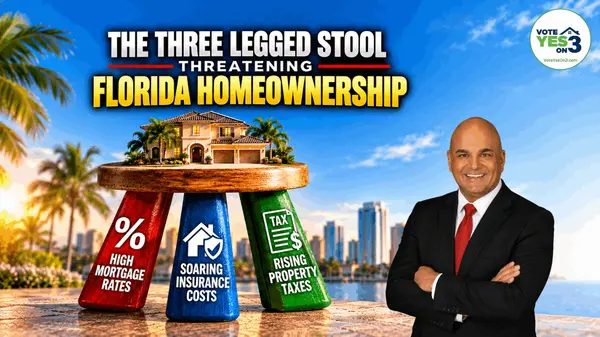
After 35 years selling real estate, I look at homeownership like a four legged chair. One leg is property taxes. The second is homeowners insurance. The third is HOA fees and assessments. The fourth is the price and equity in your home.
Those four legs ultimately have to support something extremely important: the buyer's monthly payment.
That's where I believe Florida has a serious affordability problem. Taxes, insurance and HOA costs all compete with principal and interest for the same household income. A buyer doesn't walk into my office with an unlimited amount of money and simply absorb every additional expense. There is a maximum monthly housing payment that buyer can afford.
If taxes consume more of it, something else has to give. If insurance consumes more of it, something else has to give. If HOA fees and assessments consume more of it, something else has to give.
And eventually the most flexible leg of that chair can become the price of the house.
That's why homeowners should care about these expenses even if they have owned their home for decades. Your equity isn't isolated from affordability. The value of your home ultimately depends on what another buyer is willing and able to pay for it.
SAVE OUR HOMES DOESN'T MAKE THIS PROBLEM DISAPPEAR
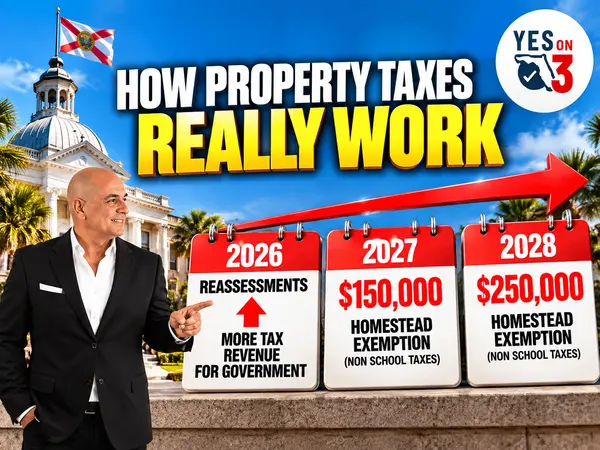
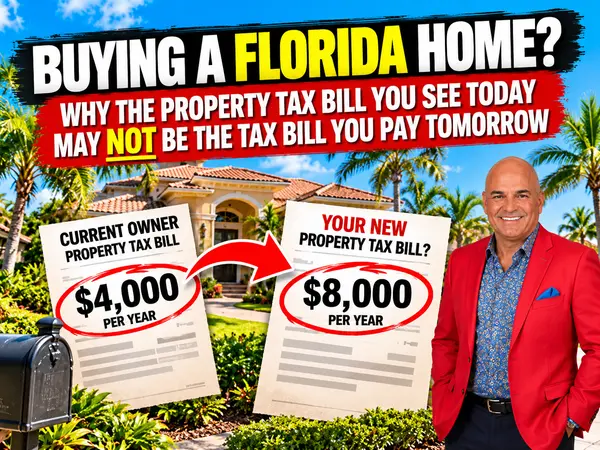
Florida's Save Our Homes protections provide significant benefits to qualifying homesteaded homeowners, and the current homestead exemption can reduce taxable value by as much as $50,000. But houses don't remain with the same owners forever. People move. People relocate for jobs. Families grow. Couples divorce. Owners downsize. People retire. And yes, eventually people die and their properties change hands. When ownership changes, the tax situation for the next owner can be dramatically different from what the longtime owner was paying. That matters because tomorrow's buyer determines today's market value.
You can have hundreds of thousands of dollars of equity on paper, but that equity only becomes real when somebody is willing and financially capable of paying the price necessary to support it.
I'VE SEEN WHAT HAPPENS WHEN EVERYONE ASSUMES REAL ESTATE CAN ONLY GO ONE DIRECTION
I was selling real estate through the housing boom of the early 2000s. I watched lending standards loosen. I watched people accumulate multiple properties. I watched buyers qualify for loans that, in my opinion, never made financial sense. At the time, almost nobody wanted to hear about the potential consequences because values were rising and everybody was making money.
Then the music stopped.
The Tampa St. Petersburg Clearwater area's FHFA home price index peaked around 290 in late 2006 and eventually fell to approximately 164 in 2012, a decline of roughly 43%. Other measures and individual neighborhoods experienced different declines, but anyone who lived through that market remembers what happened to homeowner equity.
I'm not saying today's market is 2008. The causes and financial system are different. I'm saying affordability has limits.
If the total cost of owning a home becomes disconnected from what ordinary households can afford, the real estate market eventually has to respond. That response could come through slower appreciation, stagnant prices, declining prices, changing insurance costs, lower taxes, higher incomes, lower interest rates or some combination of those factors.
But something has to restore affordability.
HOMEOWNER EQUITY IS NOT AN ENDLESS ATM
This is the part of the Amendment 3 debate I don't think we're talking about enough. Home equity represents decades of work for many Florida families. It's retirement security. It's the money someone may use to downsize. It's an inheritance. It's generational wealth. Government revenue is important. Police, fire, infrastructure and essential services have to be funded. But taxpayers are entitled to ask whether every dollar is being spent responsibly and whether government should continually expect homeowners to absorb higher costs without consequences. Florida's additional $25,000 homestead exemption dates to the changes approved in 2008, and the state's current homestead structure still provides up to $50,000 in exemption from taxable value. Meanwhile, home values, insurance costs and many other household expenses have changed enormously.
At some point taxpayers are entitled to ask: When does the homeowner get relief?
WHAT KIND OF FLORIDA ARE WE LEAVING THE NEXT GENERATION?
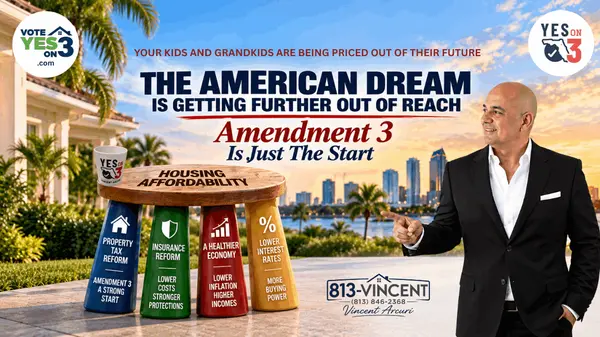
This issue is bigger than my tax bill or yours. I've been selling real estate since 1991. I've watched generations of people buy their first homes, build equity, raise families and eventually use that equity to create financial security. Today the affordability equation is becoming increasingly difficult for younger buyers. Think about what happens if buying a first home gets pushed later and later in life. Someone who becomes a homeowner at 28 has decades to pay down a mortgage and accumulate equity before retirement. Someone who can't afford their first home until their 40s or 50s starts that wealth building process dramatically later. That has consequences that stretch far beyond real estate.
It affects retirement. It affects families. It affects generational wealth. And eventually it affects the entire Florida economy.
THIS IS THE DECISION FLORIDA FACES
There are legitimate arguments on both sides of Amendment 3. Local governments have raised concerns about revenue and their ability to fund services. Homeowners and supporters of the amendment argue that property tax relief and greater spending discipline are overdue. Every voter should understand those arguments before November 3. But I believe we also need to understand the cost of doing nothing. Property taxes are one leg of the chair. Insurance is another. HOA fees and assessments are another. Your home's value and your equity are the fourth.
If the first three consume more and more of the buyer's available monthly payment, homeowners should not assume the fourth leg is untouchable. I've spent 35 years selling real estate in Tampa Bay. I've sold more than 3,000 homes. I've lived through booming markets, recessions, the Savings and Loan crisis, the housing crash, foreclosures, short sales and extraordinary recoveries. The lesson I took from all of them is simple:
Affordability eventually wins.
Government cannot assume homeowners have unlimited resources. Insurance companies cannot assume homeowners have unlimited resources. HOAs cannot assume homeowners have unlimited resources. And sellers cannot assume buyers have unlimited resources.
Eventually the numbers have to balance.
Florida voters will make their own decision on November 3. Before doing so, I encourage every homeowner to look beyond next year's tax bill and think about the long term affordability of homeownership, the value of their property and the financial future we're leaving the next generation.
For me, that's what this debate is really about. Vote YES on Amendment 3 November 3rd
Categories
Recent Posts