Why Renters Should vote YES on Amendment 3 this November 3rd
RENTERS AND AMENDMENT 3: THE PART ALMOST NOBODY IS TALKING ABOUT
If you're renting a home or apartment in Florida, you may have heard this argument about Amendment 3: “Amendment 3 gives homeowners a tax break and shifts the burden onto renters.” There's a pretty important problem with that argument. Amendment 3 contains a provision specifically affecting nonhomestead properties, including many rental properties. And it's right there in the amendment.
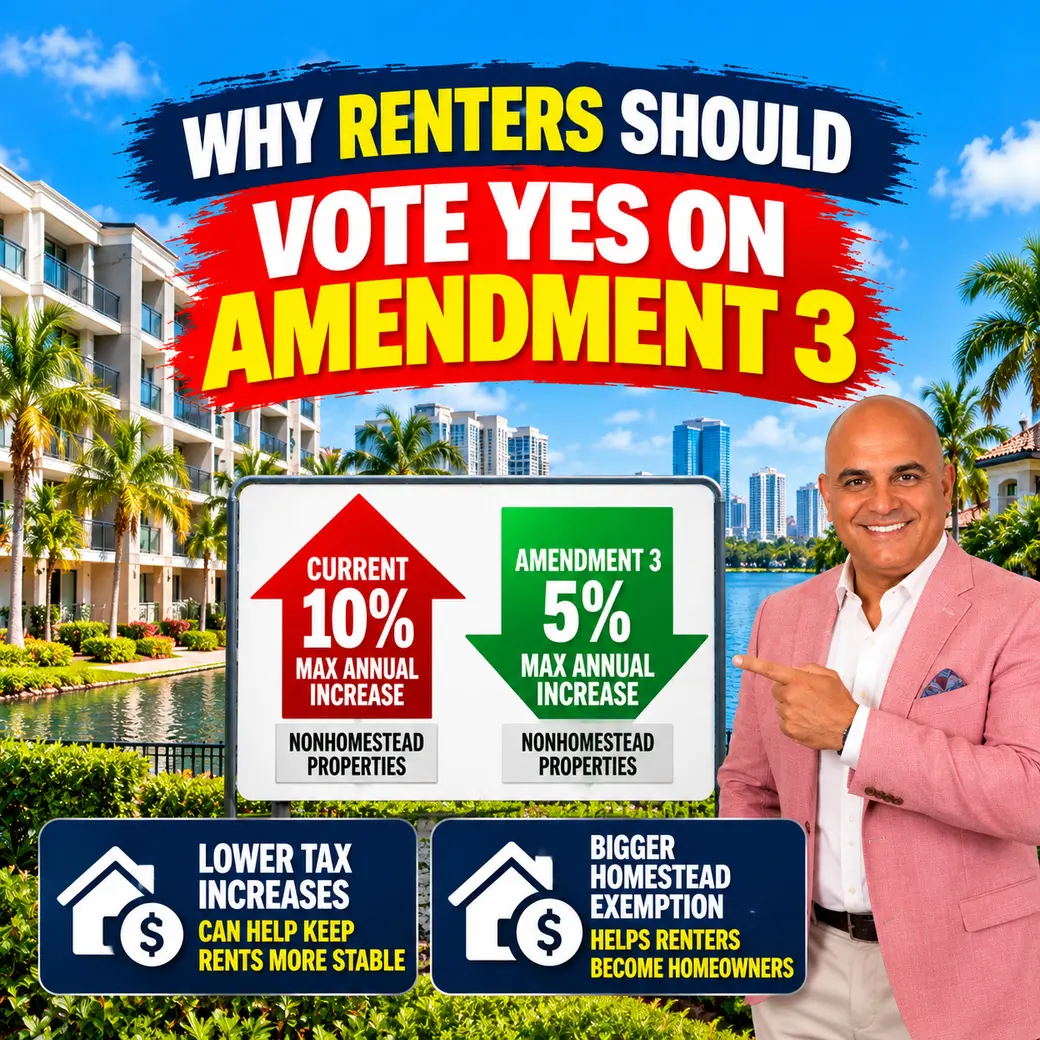
THE 10% NUMBER BECOMES 5%
Under current Florida law, qualifying nonhomestead property is generally subject to a constitutional limitation that prevents its assessed value from increasing by more than 10% annually, subject to certain exceptions. Amendment 3 would cut that maximum annual assessment increase in half, from 10% to 5%.
Why should renters care? Because somebody owns the property you're renting. And when the cost of owning that property increases, those costs don't necessarily disappear inside the landlord's checking account. Property taxes are one of the expenses of owning rental property, just like insurance, maintenance, repairs, association fees and assessments. Depending on the lease and rental market, increases in those costs can ultimately influence what landlords charge tenants.
I know this from both sides because I'm a landlord and a tenant.
I JUST SAW IT IN MY OWN LEASE
We recently signed a new lease for our office in South Tampa. The lease contains a provision that perfectly illustrates this issue: increases in property taxes can be passed directly through to us as the tenant.
Think about that. I'm not the property owner. I don't receive the property tax bill. But economically, I can still end up paying the increase.
Commercial leases frequently make these pass through arrangements explicit. Residential leases don't necessarily work the same way, and an existing lease controls what a landlord can charge during its term. But ultimately, property taxes remain part of the cost of owning rental housing. That's why the nonhomestead provision of Amendment 3 deserves considerably more attention in the discussion about renters.
AMENDMENT 3 DOESN'T JUST ADDRESS HOMESTEADS
Beginning in 2027, Amendment 3 would increase the homestead exemption applicable to taxes other than school district levies to $150,000. In 2028, it would increase to $250,000. It would also reduce the annual cap on increases in the assessed value of qualifying nonhomestead property from 10% to 5%.
That second provision matters to renters because rental homes and investment properties are generally nonhomestead property for their owners. So when someone describes Amendment 3 as though it contains nothing affecting rental property, they're leaving out an important part of the amendment.
DOES THIS MEAN YOUR RENT AUTOMATICALLY GOES DOWN? NO.
Let's be precise. Amendment 3 doesn't order landlords to lower rents. It doesn't guarantee that every landlord will pass savings along to tenants. And reducing the assessment growth cap from 10% to 5% doesn't mean an owner's total property tax bill can never increase by more than 5%. Tax bills also depend on millage rates and other factors.
What Amendment 3 does is reduce the maximum annual increase in assessed value for covered nonhomestead property from 10% to 5%. For a renter concerned about rapidly increasing housing costs, that's an important part of this amendment to understand.
THERE'S ANOTHER SIDE TO THIS FOR RENTERS: BECOMING HOMEOWNERS
Today's renter may be tomorrow's first time homebuyer. And affordability doesn't stop at the closing table. A buyer has to afford the mortgage, insurance and property taxes every month.
Amendment 3 would increase the homestead exemption applicable to non school property taxes to $150,000 in 2027 and $250,000 beginning in 2028, with inflation adjustments thereafter.
Consider someone purchasing a $400,000 starter home. The calculation isn't as simple as subtracting $250,000 from $400,000 and saying the homeowner is taxed on only $150,000 because school taxes aren't included in the increased exemption and assessed value also matters. But a qualifying homeowner could have a substantially larger portion of the home's assessed value exempt from non school property taxes than under today's system.
That can reduce the property tax obligation compared with what the same homeowner would otherwise pay. And because property taxes contribute to the monthly cost of homeownership, that matters to affordability.
THE RENTER DISCUSSION DESERVES THE WHOLE STORY
There are legitimate arguments on both sides of Amendment 3. People can debate its effect on local government revenue, spending priorities and how local governments would respond to reduced property tax collections. But renters deserve to know what's actually contained in the amendment before forming an opinion.
One provision is unmistakable: the current 10% annual cap on increases in assessed value for qualifying nonhomestead property would become 5%.
That's not speculation. That's in Amendment 3.
For renters, there are two important questions worth considering: What happens to the cost structure of the property I'm renting when growth in its assessed value is more tightly limited? And what could a substantially larger homestead exemption mean for me if I eventually become a homeowner?
Those are important questions that get lost when the entire renter discussion is reduced to the claim that property tax relief for homeowners automatically means higher costs for renters.
READ THE AMENDMENT. THEN MAKE YOUR OWN DECISION.
Whether you rent, own a home, own rental property or hope to purchase your first home, Amendment 3 can affect you differently. That's why it's important to get beyond the political talking points and look at what the amendment actually does.
For renters, one of the most important provisions may also be one of the least discussed: 10% becomes 5%.
And for renters hoping to become homeowners, the expanded homestead exemption is another part of the affordability equation worth understanding.
Vincent Arcuri
Florida Realtor Since 1991 | Over 3,200 Homes Sold
TampaPad.com
Categories
Recent Posts